Cybersecurity in the Mid-Market: Insights from Chris Arrendale (Part II)
Thought Leadership
Loading homepage…
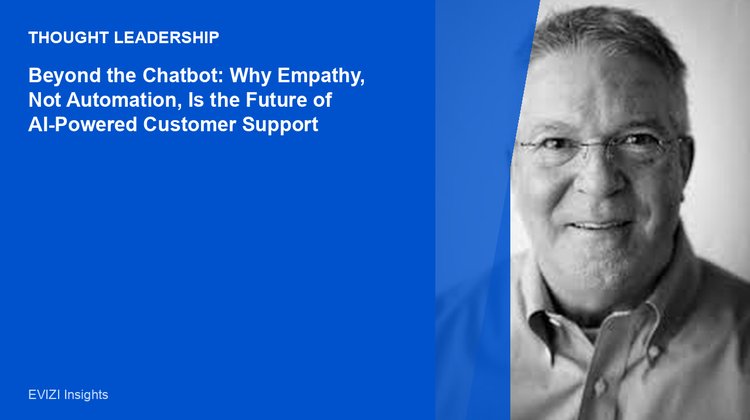
By Jeff Leroux, featuring insights from David Hare
David Hare is a 13-time TSIA award-winning customer experience leader. Having led his team to achieve the first J.D. Power Certified World -Class Support recognition, he brings decades of experience scaling support organizations across enterprise and high-growth environments. Connect with Dave on LinkedIn.
In an era where AI promises to revolutionize customer support, one truth remains stubbornly human: customers don't want to be processed. They want to be understood.
That's the central insight from a recent conversation with David Hare, a veteran of customer support transformation at both Fortune 500 companies and agile startups. While the industry debates chatbots, deflection rates, and token costs, Hare argues we're asking the wrong question. It's not "How much can AI automate?" but "How can AI make human support more human?"
"The biggest thing AI cannot currently do is have empathy for what the customer is experiencing," Hare says. "And that's not a bug. It's the current state of AI. Having support agents with excellent empathy, communications, and deductive reasoning skills will be the differentiator in how support is delivered for the foreseeable future."
For technical leaders, CTOs, CIOs, CISOs, and CEOs evaluating AI investments in support, this reframing is critical. The goal isn't to replace your team. It's to equip them.
Hare's philosophy is pragmatic: AI should handle the repetitive so humans can handle the relational.
"Support agents prefer solving difficult, technical problems rather than working on mundane or easy problems like resetting passwords," he explains. "When AI takes over the simple, predictable tasks, agent satisfaction goes up. Problem resolution accelerates. And customer satisfaction follows."
This isn't theoretical. Organizations that position AI as a "force multiplier" instead of a replacement see faster adoption, higher employee morale, and better and more predictable outcomes. The key is intentional design:
One underappreciated use case Hare highlights: preparation assistance. He cites a Department of Motor Vehicles chatbot that doesn't just answer questions. It tells customers exactly which forms they need, provides direct links, and pre-validates inputs. "The experience is more pleasant because the AI helped them prepare," he notes. "That saves appointments, reduces internal queue pressure, and builds trust."
The lesson? AI's highest value isn't always in solving the problem. It's in setting up the human to solve it faster.
When asked to reimagine customer support infrastructure with AI at its core, Hare describes a layered architecture:
"This isn't about limiting access," Hare clarifies. "It's about matching the right resource to the right need, faster."
A powerful example: using AI as a proactive churn detector. By overlaying AI on CRM data, organizations can flag accounts showing risk patterns, like three severity-one tickets in three weeks, and automatically assign a senior escalation engineer before the customer considers leaving.
"I've used this approach to secure renewals that were already in jeopardy," Hare says. "The AI didn't save the account. It gave the human the context and timing to save it."
For technical leaders, the infrastructure question isn't "Which AI vendor?" but "How do we design workflows where intelligence amplifies judgment?"
One of the most significant shifts Hare advocates is moving from measuring activity to measuring outcomes.
"The traditional model counts closed tickets," he explains. "But that rewards speed, not resolution. After AI implementation, we should ask: Did the customer pay their support bill on time? Did they ask for a discount? Did they renew?"
He proposes three outcome-focused metrics to replace ticket volume:
| Old Metric | New Metric | Why It Matters |
|---|---|---|
| Tickets closed | Prevention rate | Measures how AI stopped issues before they escalated |
| Average handle time | Resolution confidence | Tracks whether customers felt truly helped |
| Deflection rate | Feedback quality | Evaluates if AI-collected data improved product or engineering decisions |
Most importantly, Hare emphasizes feeding support insights back to product teams. "Support knows more about customer pain points than any other organization," he says. "AI can categorize thousands of interactions: documentation gaps, defects, how-to questions. Then present logical priorities to engineering. That's how support becomes a growth engine, not a cost center."
Here's where many AI initiatives stumble: training models on incomplete or inaccurate data.
"Agents often close tickets without documenting the full solution," Hare warns. "If AI learns from those tickets, it will give customers incomplete answers. One bad recommendation can have catastrophic business consequences."
His recommendation for technical leaders: audit before you automate.
"Data integrity isn't a prerequisite. It's the foundation," Hare says. "Without it, AI doesn't scale intelligence. It scales mistakes."
This principle extends to knowledge management. Hare believes traditional, static knowledge bases will become obsolete. "AI-literate organizations will use agents that combine internal knowledge with multi-vendor context: Apple, Salesforce, Microsoft. They resolve problems holistically," he predicts. "Companies clinging to manual knowledge bases will fall behind."
As AI absorbs technical tasks, the skills that matter most in support are becoming unmistakably human.
"I once managed a highly technical support team with the lowest customer satisfaction scores in the industry," Hare recalls. "We shifted hiring to prioritize communication and empathy. Satisfaction scores jumped. It's easier to teach technical skills than to teach someone to care."
For leaders building AI-augmented teams, this means:
Before investing in AI for support, Hare says every organization must answer one question:
"What is the outcome you’re looking to use it for?"
Not "What can AI do?" Not "What is our competition using?" But: What specific outcome will this improve?
"If you can't articulate the outcome," Hare cautions,
"you're not implementing AI. You're checking a box."
The future of customer support isn't fully automated. It's intelligently orchestrated.
AI handles what it does well: pattern recognition, data synthesis, repetitive execution. Humans handle what they do best: empathy, judgment, relationship-building. The magic happens in the handoff.
For technical leaders evaluating AI investments, the framework is clear:
"The best AI implementations doesn’t hide the human," Hare concludes. "They make the human more effective. That's not just good support. That's good business."
This article is part of Evizi's thought leadership series on intelligent enterprise systems. Explore more insights on human-centric automation, outcome-driven metrics, and the future of work at Evizi.com.